For six months, the same scene repeated itself.
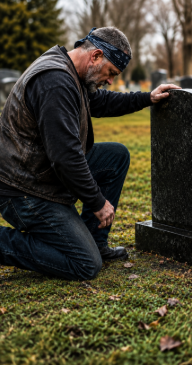
Every Saturday afternoon, almost exactly at two o’clock, a man on a Harley-Davidson motorcycle would enter the cemetery, park a short distance from the gates and walk toward my wife’s grave.
He never came with flowers.
He never spoke to anyone.
He simply sat beside her headstone for nearly an hour.
Then, before leaving, he would place one hand against the stone, remain there for a few seconds, and walk away.
At first, I tried to ignore him.
Grief had already changed the way I saw the world. After losing Sarah, I had learned that strangers could become temporary companions in mourning without ever saying a word.
But this man kept coming.
Week after week.
Month after month.
And eventually, I could no longer stop wondering why.
Sarah had been a pediatric nurse. She spent most of her adult life caring for sick children and worrying about everyone except herself. She was a mother, a wife, and the person who could turn an ordinary evening into something memorable simply by laughing at the right moment.
She had never been interested in motorcycles.
She disliked loud engines.
She preferred quiet weekends, books, family dinners and walks with our children.
That was why the stranger seemed so completely out of place.
He was everything I would never have associated with Sarah.
He was large, heavily tattooed and usually dressed in black motorcycle clothing. His gray hair escaped from beneath his helmet, and his beard made him look older than I initially thought.
Yet whenever he reached Sarah’s grave, the tough exterior disappeared.
He became a different man.
He would sit quietly.
Sometimes he lowered his head.
Sometimes I saw him wipe his eyes.
And sometimes he simply stared at her name.
The first time I noticed him
Sarah had been gone for several months when I first saw the motorcycle.
I was visiting her grave with our children.
They had brought small flowers from the garden.
Our youngest was still at the age where she believed that if we talked loudly enough, Mom might somehow hear us.
I was trying to answer her questions without breaking down myself when the sound of a motorcycle approached.
The man parked and removed his helmet.
He looked toward us.
For a moment, I thought he might leave.
Instead, he walked directly toward Sarah’s grave.
I instinctively stepped closer to the children.
He noticed me and stopped.
Neither of us said anything.
Then he looked at Sarah’s name, lowered his head and quietly walked away.
I assumed it was a coincidence.
The following Saturday, he returned.
And the Saturday after that.
Soon I began noticing the pattern.
Two o’clock.
Every Saturday.
Always alone.
Always for approximately an hour.
Then gone.
The questions became impossible to ignore
I asked Sarah’s parents whether they knew him.
They did not.
Her brother had never seen him.
None of her close friends recognized the description.
I even asked several of her former coworkers at the hospital.
Nothing.
That made the situation stranger.
Sarah had worked with hundreds of people over the years. Surely someone connected to her would know this man.
But nobody did.
Meanwhile, he continued visiting.
There was something almost ritualistic about the way he behaved.
He never looked at the other graves.
He never wandered around the cemetery.
He went straight to Sarah.
Sometimes he brought something small in his jacket pocket.
Once, I noticed what looked like a folded piece of paper.
He placed it beneath his hand on the headstone and sat there silently.
I wondered whether it was a photograph.
A letter.
Perhaps an old hospital identification card.
I never got close enough to know.
Grief can make ordinary things feel threatening
Looking back, I realize that my suspicion was partly fueled by grief.
When someone you love dies unexpectedly, your mind searches for explanations.
You replay conversations.
You remember places you visited.
You examine details you once considered meaningless.
You begin wondering whether there were parts of their life you never knew.
That was exactly what happened to me.
Sarah and I had been married for years.
I believed I knew her.
But this stranger made me question that certainty.
Who was he?
Why had Sarah never mentioned him?
Why did he mourn her so intensely?
And why did he seem to know exactly where she was buried?
I tried to convince myself that there was a harmless explanation.
Perhaps Sarah had helped him once.
Perhaps she had treated someone in his family.
Perhaps they had crossed paths through the hospital.
But each possibility raised another question.
If their relationship had been important, why had Sarah never told me?
Then my anger finally won
Six months after the stranger’s visits began, I reached my limit.
It happened on a rainy Saturday.
I was already at the cemetery when I heard the familiar motorcycle.
He parked.
Removed his helmet.
And walked toward Sarah’s grave.
This time, I followed him.
He sat down.
I stood several feet away.
For nearly a minute, I said nothing.
Then I asked:
“Who are you?”
He looked over his shoulder.
His expression changed immediately.
He seemed surprised that I was speaking to him.
I took another step forward.
“I’ve seen you here every Saturday. You knew my wife. I want to know how.”
He slowly stood.
For the first time, I could see his face clearly.
There were tears in his eyes.
That only made me angrier.
“You don’t get to come here every week and mourn her without explaining why,” I said.
He looked at the headstone.
Then at me.
His voice was quiet.
“Your wife was my…”
He stopped.
I waited.
He swallowed hard.
Then he finished the sentence.
And everything I thought I knew about Sarah changed.
A connection I had never imagined
The man introduced himself as Daniel.
He had known Sarah years before I met her.
Not as a romantic partner.
Not as a secret husband.
His connection to her was something far more complicated.
Daniel had once been the father of a little girl Sarah had cared for as a pediatric nurse.
The child had been seriously ill.
Sarah had been assigned to her case.
Over time, she had become one of the few people who could make the frightened little girl smile.
Daniel remembered her sitting beside his daughter’s bed long after her shift had ended.
He remembered Sarah bringing drawings, reading stories and speaking to his daughter as though she were not a patient, but simply a child who deserved to feel safe.
The girl eventually died.
Daniel never forgot Sarah.
But that was not the entire reason he visited her grave.
There was another part of the story.
One Sarah had apparently never told me.
The promise
Before Daniel’s daughter died, Sarah had made a promise.
She had told the little girl that someone would always remember her.
Daniel explained that after the funeral, he struggled to continue his life.
He withdrew from people.
He stopped visiting the hospital.
He eventually moved away.
Years passed.
Then Sarah found a way to contact him.
She sent him a letter.
In it, she told him that she still remembered his daughter.
She described one particular drawing the little girl had made.
Daniel had kept that letter.
He had kept the drawing, too.
When Sarah died, he learned about it through an old hospital contact.
He came to the cemetery once.
Then again.
Eventually, visiting her grave became a ritual.
Not because he believed Sarah had belonged to him.
Because she was one of the few people who had treated his daughter’s memory as something precious.
The motorcycle was simply how he traveled.
The grave was simply where he could say thank you.
The truth was harder to hear than I expected
I stood there feeling ashamed.
For months, I had imagined secrets.
I had wondered whether my wife had hidden an entire relationship from me.
I had allowed suspicion to grow because I couldn’t understand why another man was grieving her.
But there had never been betrayal.
There had been kindness.
A kind of kindness Sarah had practiced so naturally that she apparently never considered it important enough to tell me about.
Daniel reached into his jacket.
He removed the folded paper I had seen him holding on previous visits.
It was a copy of Sarah’s letter.
He had brought it with him because he wanted me to understand.
I read it.
There was nothing romantic in it.
Nothing suspicious.
It was simply Sarah being Sarah.
She had written about a child who had been frightened, about a father who had refused to leave his daughter’s side, and about how deeply she believed that people should continue speaking about those they had lost.
I had to stop reading because my vision became blurred.
Daniel didn’t say anything.
He didn’t need to.
The meaning of those Saturday visits
After that day, I never again looked at the motorcycle the same way.
Daniel continued coming to the cemetery.
So did I.
Sometimes we arrived at the same time.
At first, neither of us knew what to say.
Eventually, we began talking.
He told me stories about Sarah that I had never heard.
I told him stories about the woman she became after we met.
We discovered that we knew different versions of the same person.
And both versions were real.
Sarah had been my wife.
To our children, she was their mother.
To her colleagues, she had been a nurse.
To Daniel’s daughter, she had been one of the adults who made a frightening world feel a little safer.
To Daniel, she became part of the memory of the child he lost.
None of those relationships canceled out the others.
They existed alongside one another.
What grief sometimes reveals
The experience taught me something I wish I had understood earlier.
We never know the full impact of another person’s life.
A person can leave behind dozens of small acts of kindness that they never consider remarkable.
A nurse stays five minutes longer.
A teacher remembers a child’s name.
A neighbor makes a phone call.
A stranger offers comfort.
Years later, those moments may be the very things someone remembers most clearly.
Sarah never knew how important her kindness had been to Daniel.
Perhaps she never would have imagined that a man who looked so intimidating would spend half a year sitting quietly beside her grave.
And I never knew that the woman I married had left such a lasting impression on a family she had once helped.
The motorcycle had frightened me because I did not understand it.
Once I knew the story, it became something else entirely.
It became a reminder.
Not of a secret.
Not of betrayal.
But of the invisible connections people leave behind.
The following Saturday, I arrived at Sarah’s grave a little before two.
Daniel was already there.
He looked up and nodded.
I sat beside him.
For a while, neither of us spoke.
We simply looked at Sarah’s name.
And for the first time, I understood why he kept returning.
He wasn’t trying to hold on to the past.
He was refusing to let gratitude disappear with it.
Sometimes the people who visit a grave are carrying stories we could never imagine.
And sometimes, the stranger we are most suspicious of is simply someone who loved the person we lost in a completely different way.