It was a swimming pool.
For most people, it might have been nothing more than a rectangle of blue water in a backyard. But for Elena and her three children, that pool had become something much more meaningful. It was where the children laughed through difficult summers, where their father taught them to swim, and where the family continued to gather after his illness made ordinary days increasingly precious.
After his death, Elena could hardly bring herself to change anything around the house.
His favorite chair remained by the window. His tools stayed exactly where he had left them. Even the old towel hanging beside the pool seemed impossible to move.
The children, however, still went outside.
They needed somewhere to be children again.
Their father’s illness had taken much from them, and after losing him, the pool became one of the few places where they could forget, even temporarily, how much their family had changed.
Then Diane moved into the neighboring property.
At first, Elena tried to be welcoming.
She introduced herself, explained that she was raising three children, and assured Diane that she would do her best to be considerate.
But Diane seemed irritated almost immediately.
The children’s laughter carried across the fence.
The splashing disturbed the quiet afternoons.
Friends occasionally visited.
And whenever Elena’s children played in the pool, Diane appeared at the boundary of her property with an increasingly hostile expression.
The complaints began politely.
Then they became demands.
She insisted that the children stop using the pool so early in the morning.
Then she complained about afternoon noise.
Eventually, even the sound of people talking became an issue.
Elena tried to compromise.
She established reasonable hours. She asked the children not to scream near the fence. She stopped allowing music outside.
Nothing seemed to satisfy Diane.
One afternoon, Diane stood at the fence and told Elena that the pool had to go.
Elena refused.
It was not simply a swimming pool.
It was one of the last places where her children felt close to their father.
Diane did not appear interested in understanding that.
Instead, she began looking for another way to get what she wanted.
What Elena did not know was that Diane had already been asking questions about the property.
She had discovered that Elena’s husband had owned the house for many years. She had also learned that the backyard contained an old structure connected to the original property plans.
For reasons Elena did not understand, Diane seemed unusually interested in what lay beneath the surface of the yard.
Then, one morning, Elena woke to the sound of machinery.
She rushed outside.
Several workers were standing beside the pool.
A truck was parked near the gate.
And the water was already being drained.
Elena froze.
“What are you doing?”
One of the workers looked uncomfortable.
Before he could answer, Diane appeared.
She calmly informed Elena that the pool was going to be filled.
Not repaired.
Not covered temporarily.
Filled with concrete.
Elena immediately protested.
She explained that she had never authorized the work.
The children stood behind her, frightened and confused.
This was the place their father had built for them.
The place where they had celebrated birthdays.
The place where he had spent his final healthy summer playing with them.
Diane simply shrugged.
She claimed that the pool was a nuisance and that Elena would eventually understand that removing it was for the best.
But Elena knew something was wrong.
She demanded to see the permits.
The workers exchanged glances.
Diane became increasingly aggressive.
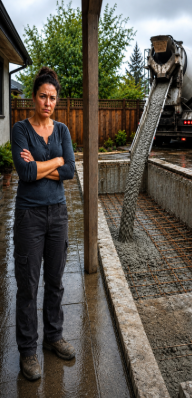
Yet before Elena could stop what was happening, the first load of concrete was poured.
By the end of the morning, the pool that had held so many memories was buried beneath a solid gray surface.
Her children cried.
Elena did not.
She stood silently beside them.
For years, she had learned that grief did not always look like tears.
Sometimes grief looked like silence.
Sometimes it looked like remembering the exact sound of a loved one’s laugh.
And sometimes, it looked like deciding that someone had finally gone too far.
That afternoon, Elena made several phone calls.
She did not threaten Diane.
She did not confront her.
She simply began making inquiries.
First, she contacted the county office responsible for property records.
Then she spoke with an attorney.
Finally, she called someone whose name had been written in an old folder belonging to her late husband.
What she discovered changed her understanding of the entire situation.
The pool had not been an ordinary addition to the property.
Years earlier, when Elena’s husband had purchased the house, he had discovered old documentation concerning the neighboring lots.
There was an unusual easement recorded against the property.
It involved access to a section of land that, according to the official records, had a very different history from what anyone in the neighborhood believed.
The more Elena learned, the stranger the story became.
And there was another detail.
The property Diane had purchased was not entirely as straightforward as it appeared.
Some of the documents associated with the neighboring lot had been altered over the years.
The county records contained information that did not match the documents Diane had apparently relied upon.
Elena’s attorney advised her not to make accusations until everything had been verified.
So she waited.
For the first time since her husband’s death, she found herself thinking not about revenge, but about facts.
She wanted to know why Diane had been so determined to destroy the pool.
Why had she cared so much?
Why had she been asking questions about the yard?
And why had she acted as though she had some authority over Elena’s property?
A few days later, the answers began to emerge.
The old property records suggested that Elena’s husband had known something important about the land.
Something he had never fully explained to her.
There was a section of the original property boundary that had been disputed decades earlier.
Her husband had apparently spent years investigating it.
The documents indicated that the land beneath part of the backyard could be connected to a long-standing legal claim.
The pool had unknowingly been built over an area that mattered.
And Diane knew it.
That was why she wanted it destroyed.
She had not been trying merely to silence the children’s laughter.
She had been trying to remove something that stood in the way of her own plans for the property.
But she had made one enormous mistake.
By ordering the pool destroyed, she had drawn attention to the exact area she had hoped nobody would investigate.
Elena’s attorney requested an official survey.
The survey produced a result that shocked everyone involved.
Part of the boundary Diane believed belonged entirely to her property was not where she thought it was.
The situation was complicated, and the final determination depended on historical records, property descriptions, and local law. But one thing became increasingly clear:
Diane had acted far more confidently than her legal position justified.
Then came the confrontation.
Diane crossed the lawn toward Elena’s house, furious.
Her confidence was gone.
She had learned that the county had begun reviewing the property records.
She had also discovered that Elena’s late husband had preserved copies of documents that could become important evidence.
Diane was no longer demanding that Elena remove the pool.
There was no pool left to remove.
Instead, she was asking Elena to stop the investigation.
Elena listened quietly.
Then Diane said something that revealed more than she intended.
She admitted that she had known there was something unusual about the property before she purchased her house.
She had believed the matter could be resolved quietly.
The pool had interfered with her plans.
She thought destroying it would make the problem disappear.
It did the opposite.
It brought everything into the open.
Elena finally understood why her husband had kept those old papers.
Perhaps he had suspected that the property boundaries would someday matter.
Perhaps he had simply been careful.
The exact reason remains uncertain.
What is certain is that those documents gave Elena something she had not expected to receive after her husband’s death: a final piece of evidence about the life they had built together.
The legal dispute was eventually handled through the proper channels.
Elena did not need to take revenge herself.
The records, surveys, and official procedures did what anger never could.
And Diane’s greatest mistake was not merely destroying the pool.
It was assuming that Elena was powerless because she was grieving.
The children eventually returned to the backyard.
The concrete slab remained for a while, an ugly reminder of what had happened.
But Elena refused to let it become the final memory of their father.
She decided to transform the space.
Instead of rebuilding the same pool, she created a small garden and memorial area for the children.
They planted flowers.
They placed a simple bench beneath a tree.
And one summer evening, Elena found her youngest child sitting there quietly.
“Do you think Dad would like it?” the child asked.
Elena smiled through her tears.
“I think he would.”
The pool was gone.
The laughter that had once echoed across the yard was different now.
But the memories remained.
And perhaps that was the part Diane had never understood.
You can destroy a structure.
You can pour concrete over water.
You can erase something visible from the surface.
But you cannot erase what a family experienced there.
In the end, Diane’s attempt to eliminate a source of irritation uncovered a much deeper story—one involving property records, old promises, and a secret Elena’s husband had apparently been protecting for years.
And the cruel irony was that the very act intended to make the past disappear became the reason the truth finally came to light.
Elena never got her old backyard back.
But she gained something more important.
She learned that her husband’s final legacy was not the pool itself.
It was the life they had created around it.
And no amount of concrete could bury that.