There are some public figures whose stories seem to belong to a particular moment in history. Their photographs fade into archives, their names gradually become associated with another generation, and the emotions that once surrounded them lose their intensity.
Princess Diana has never quite followed that pattern.
Decades after her death, her image remains instantly recognizable. Documentaries continue to examine her life, younger generations discover her story for the first time, and people who remember the extraordinary events of 1997 still speak about them with remarkable emotion. A photograph, a bouquet of flowers, or a quiet visit connected with her memory can be enough to bring back an entire chapter of modern history.
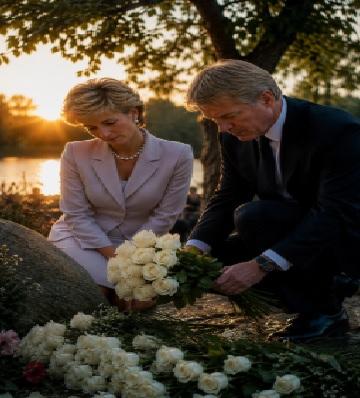
The number 28 carries a particularly poignant symbolism: twenty-eight years passed between Diana’s death in 1997 and the anniversary marked in 2025. Whether expressed through flowers, private remembrance, or public tributes, the passage of time has done surprisingly little to erase the fascination surrounding the woman who became known around the world as the «People’s Princess.»
But perhaps the more important question is not how Diana is remembered.
It is why.
A Life Lived Under an Extraordinary Spotlight
Diana Frances Spencer was only 20 years old when she married Charles, then Prince of Wales, in 1981. Their wedding became one of the defining television events of its era, watched by an enormous international audience.
Almost overnight, a young woman who had previously lived a relatively private life became one of the most photographed people on Earth.
From that moment, virtually everything about Diana attracted attention: her clothes, her expressions, her public appearances and, eventually, the difficulties in her marriage.
Yet the public fascination with Diana was never based entirely on royal glamour.
Something about her appeared unusually accessible.
During official engagements, she often seemed less interested in maintaining distance than in establishing personal contact. Photographs repeatedly captured her crouching down to speak with children, holding hands with patients and interacting naturally with people who might otherwise have felt intimidated by a member of the Royal Family.
These moments contributed to a public image that was very different from traditional ideas of royal formality.
Diana understood the power of human contact.
One of the most significant examples came during the AIDS crisis. At a time when misinformation and fear surrounding HIV and AIDS were widespread, Diana was publicly photographed shaking hands with an HIV-positive patient without wearing gloves.
Today, such an action may appear ordinary. In the context of the late 1980s, however, the symbolism was powerful.
It helped challenge the false belief that HIV could be transmitted through casual physical contact. Diana’s involvement did not solve the enormous social and medical challenges surrounding the epidemic, but her visibility helped bring attention to the stigma faced by patients.
Her humanitarian work later extended to other causes, including efforts connected with the campaign against landmines. Images of Diana walking through a cleared path in a minefield in Angola in 1997 became among the most memorable photographs of the final year of her life.
Her ability to direct global attention toward humanitarian issues became an important part of her legacy.
Behind the Public Image
The story of Diana was also complicated.
The fairy-tale narrative surrounding her royal wedding gradually collapsed as the difficulties in her marriage became public knowledge. The relationship between Diana and Charles deteriorated under intense media scrutiny, and their separation was announced in 1992. Their divorce was finalized in 1996.
During those years, Diana became an even greater focus of international media attention.
Her personal life was discussed constantly. Photographers followed her movements, newspapers competed for exclusive images, and almost every appearance became a potential global story.
This relentless attention created one of the central contradictions of Diana’s life.
The media helped transform her into an international icon, yet the same machinery of celebrity culture also contributed to an environment in which privacy became extraordinarily difficult.
Diana herself sometimes used media attention strategically, particularly when drawing attention to humanitarian causes. At the same time, she experienced the darker consequences of living under permanent observation.
That complicated relationship between celebrity, journalism and privacy remains relevant today.
Long before smartphones and social media made constant exposure part of everyday life, Diana’s experience demonstrated what could happen when public curiosity became almost limitless.
The Night That Changed Everything
On August 31, 1997, Diana died following a car crash in the Pont de l’Alma tunnel in Paris. She was 36 years old.
Dodi Fayed and driver Henri Paul also died. Bodyguard Trevor Rees-Jones survived.
The news produced an extraordinary international reaction.
Outside Kensington Palace, people began leaving flowers, messages and personal tributes. The scale of public mourning grew rapidly, creating scenes that became symbolic of the emotional response to Diana’s death.
For many people, the reaction felt deeply personal despite the fact that they had never met her.
That phenomenon remains one of the most remarkable aspects of Diana’s story.
People were not simply mourning a royal title. Many believed they had lost someone whose vulnerabilities they had witnessed in public.
They had watched her marry.
They had watched her become a mother.
They had watched the breakdown of her marriage.
They had seen her humanitarian work and followed her attempts to establish a new life after divorce.
Her story had unfolded in front of the world for more than fifteen years.
When it ended suddenly, millions felt that something familiar had disappeared with her.
The Brother Who Spoke for a Grieving Family
Among the most significant figures in the story of Diana’s memory is her younger brother, Charles Spencer, the 9th Earl Spencer.
At Diana’s funeral in Westminster Abbey on September 6, 1997, he delivered a eulogy that became one of the most discussed moments of the ceremony.
His words reflected grief but also addressed the intense pressures Diana had faced. The speech resonated strongly with many members of the public and became part of the historical memory surrounding her funeral.
After the ceremony, Diana was buried at Althorp, the Spencer family’s ancestral estate in Northamptonshire.
Her grave is located on an island in the Round Oval lake, creating a setting separated from the main areas visited by the public.
The decision gave Diana’s final resting place a degree of privacy that had often been absent from her life.
There is something profoundly symbolic about that contrast.
A woman who spent much of her adult life surrounded by cameras was finally laid to rest in a secluded place.
For her family, remembrance is naturally different from the public fascination that continues around her name. Behind the documentaries, photographs, anniversaries and historical debates is the reality that Diana was also a daughter, sister and mother.
That distinction matters.
Public memory turns people into symbols.
Families remember human beings.
Why Flowers Still Matter
Flowers became inseparable from the visual memory of Diana’s death.
In the days after the Paris crash, enormous numbers of bouquets appeared outside royal residences. Images of the floral tributes were broadcast around the world.
Ever since, flowers associated with Diana’s memory have carried an emotional meaning that goes beyond decoration.
A single bouquet can represent something simple: remembrance without spectacle.
The idea of 28 flowers, one for each year since her death, is therefore a powerful symbolic image. But symbolism should not be confused with documented fact. Unless a particular tribute is confirmed by reliable sources, details about who placed specific flowers, what was said at a private moment, or exactly what happened at Diana’s grave should not be presented as historical truth.
The verified story is already powerful enough.
Twenty-eight years represent an entire generation.
Children born in 1997 have become adults. Many people who know Diana today were not alive when she died. They encounter her through photographs, interviews, television dramas, documentaries and the memories of their parents.
Yet the interest continues.
That suggests Diana’s legacy has moved beyond nostalgia.
William, Harry and a Legacy That Continues
For Prince William and Prince Harry, Diana’s death was not primarily a historical event or a global news story.
It was the loss of their mother.
William was 15 years old when Diana died, while Harry was 12.
Over the years, both have spoken publicly at different times about the impact of losing their mother at such young ages. Their experiences have inevitably shaped the way the public understands Diana’s legacy.
But Diana’s memory should not be reduced to speculation about what she might think of events that occurred after her death.
No one can reliably know what she would have said about the lives and decisions of her adult sons, the evolution of the monarchy, or the dramatic changes that have taken place within the Royal Family.
Such questions may generate headlines, but they remain speculation.
What can be said with confidence is that Diana’s influence continues through the historical memory of her public work and through the lives of the two sons she loved.
More Than a Royal Story
Perhaps the reason Diana remains compelling is that her life contained contradictions that still feel modern.
She possessed enormous privilege yet frequently appeared emotionally vulnerable.
She was one of the most famous women in the world yet struggled for privacy.
She belonged to the monarchy yet became known for breaking through some of the emotional distance traditionally associated with royal life.
She was celebrated, criticized, pursued and idealized.
And she was only 36 when her life ended.
Because of that, Diana’s story has never acquired the neat conclusion that history sometimes gives to long lives.
There is always an unfinished quality to it.
People continue asking who she might have become.
Would she have expanded her humanitarian work?
How would she have adapted to the age of social media?
What relationship would she have had with the modern monarchy?
What kind of grandmother would she have been?
There are no factual answers to these questions, and pretending otherwise would turn imagination into history.
But the fact that people still ask them reveals something important.
The world did not feel finished with Diana when she died.
Twenty-Eight Years Later
Time usually creates distance.
In Diana’s case, it has created perspective without completely removing the emotion.
The extraordinary public reaction to her death now belongs to history, but many of the issues connected with her life remain strikingly contemporary: the psychological cost of fame, the ethics of media intrusion, the power of celebrity to support humanitarian causes, and the complicated relationship between public institutions and personal vulnerability.
Perhaps that is why even the simplest act of remembrance can still attract attention.
Twenty-eight flowers do not need an invented conversation to have meaning.
They can stand quietly for twenty-eight years.
Twenty-eight anniversaries.
Twenty-eight reminders of how quickly one night can become history.
And behind all the mythology remains the story of Diana Spencer: a woman who entered royal life at a remarkably young age, became a global celebrity, raised two sons under extraordinary public scrutiny, used her visibility to draw attention to humanitarian causes, and died before she had the opportunity to discover what the next chapter of her life might have been.
The world has changed dramatically since August 1997.
Diana’s photograph, however, still has the ability to make millions of people stop and remember.
Perhaps that is the most enduring tribute of all.
Not a dramatic revelation.
Not a secret sentence supposedly spoken beside a grave.
Just the persistence of memory — and the remarkable fact that, after all these years, people are still unwilling to forget.