“Can you please save my mom?”
The restaurant was busy. The clatter of silverware, the hum of conversations, and the smell of fresh coffee made it seem like an ordinary afternoon. We were sitting together as we did every month—fifteen men in leather vests, most of us veterans who had seen wars, tragedies, and more than a few hard lessons in life.
But the moment that little boy spoke, everything around us seemed to disappear.
He couldn’t have been more than eight years old. He wore an old dinosaur T-shirt and sneakers that had clearly seen better days. In his hands, he clutched several crumpled bills.
“I have seven dollars and thirty cents,” he said seriously. “It’s all I have.”
No one knew how to respond.
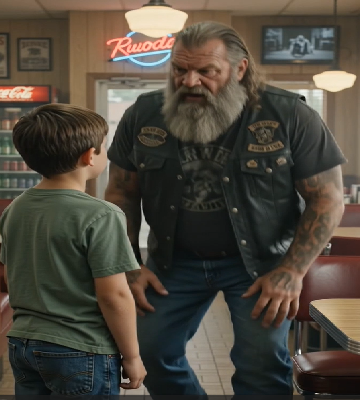
Big Mike, the president of our club, leaned forward.
“What’s your name, buddy?”
“Adam.”
“And why do you need us to save your mom?”
The boy lowered his eyes.
“Because she’s scared.”
That simple sentence hit all of us harder than anything else could have.
“Scared of what?” Mike asked softly.
Adam hesitated for a moment.
Then he answered.
“Of the man who’s supposed to protect us.”
After those words, we began noticing things we hadn’t seen before.
A small scar beneath his eye.
A bruise on his forearm.
The way he flinched ever so slightly whenever there was a loud noise nearby.
It didn’t take much imagination to understand that things weren’t okay at home.
Just then, his mother returned from the restroom.
She was young. Beautiful. But exhausted.
Not the kind of exhausted that comes from a long day at work.
The kind that builds up over months—or years.
When she saw her son standing at our table, her face went pale.
“Adam!”
She hurried over.
“I’m so sorry if he’s bothering you.”
“He’s not bothering us at all,” Mike replied.
Her smile was fragile.
Too fragile.
Then she noticed the money on the table.
And she understood.
Tears instantly filled her eyes.
“Adam…”
The boy turned toward her.
“Mom, they look strong.”
No one said a word.
She slowly sat down.
For several long seconds, she stared at the table.
Finally, she whispered:
“I didn’t realize he’d noticed.”
“Children notice everything,” one of the veterans said.
And it was true.
Sometimes more than adults do.
Over the next hour, she gradually shared her story with us.
How she had met a man who initially seemed kind.
How he changed after they married.
How the insults came first.
Then the threats.
Then the fear.
And eventually, the violence.
But the worst part wasn’t the bruises.
The worst part was believing she had nowhere to go.
That no one would help.
That no one would believe her.
That’s how abusers maintain their power.
Not through strength.
Through isolation.
Through hopelessness.
When she finished speaking, she sat quietly with her head lowered.
Adam held her hand tightly.
Mike looked around the table.
Every one of us knew what he was thinking.
We couldn’t change the past.
But we could help change what came next.
That very evening, we contacted organizations that support victims of domestic violence.
One of our members knew an attorney.
Another had connections with a social worker.
Someone arranged safe housing.
Someone else organized transportation.
Within hours, a plan began to take shape.
Not a plan for revenge.
A plan for rescue.
Because true strength isn’t about hurting someone.
True strength is about stopping suffering without creating more of it.
The weeks that followed weren’t easy.
They were filled with court hearings.
Statements.
Fear.
Uncertainty.
But Adam and his mother were no longer alone.
And that changed everything.
A few months later, we organized a charity event.
Hundreds of motorcycles arrived.
The proceeds went to women and children escaping domestic violence.
As the event came to an end, Adam walked over to us.
This time, he was smiling.
In his hand, he held his school report card.
“All A’s,” he announced proudly.
The entire table burst into applause.
Mike knelt beside him.
“So, buddy?”
Adam thought for a moment.
“I know what being strong means now.”
“And what does it mean?”
The boy looked at his mother.
A woman who, for the first time in a long while, genuinely looked happy.
Then he answered:
“Not giving up, even when you’re scared.”
For a moment, nobody spoke.
Because we all knew that an eight-year-old boy had just spoken one of life’s greatest truths.
That day, we learned something important.
Heroes don’t always wear uniforms.
They don’t always ride motorcycles.
They don’t have to be big or powerful.
Sometimes, a hero is a little boy brave enough to ask for help.
And sometimes, all it takes is for someone to listen.
That can save a life.